


Organics
We are trying to help gather information on current infrastructure as well as learn what the community would like more of in this regard. Please see take our survey below or reach out to us at ioniacd@gmail.com!
WHAT A WASTE!
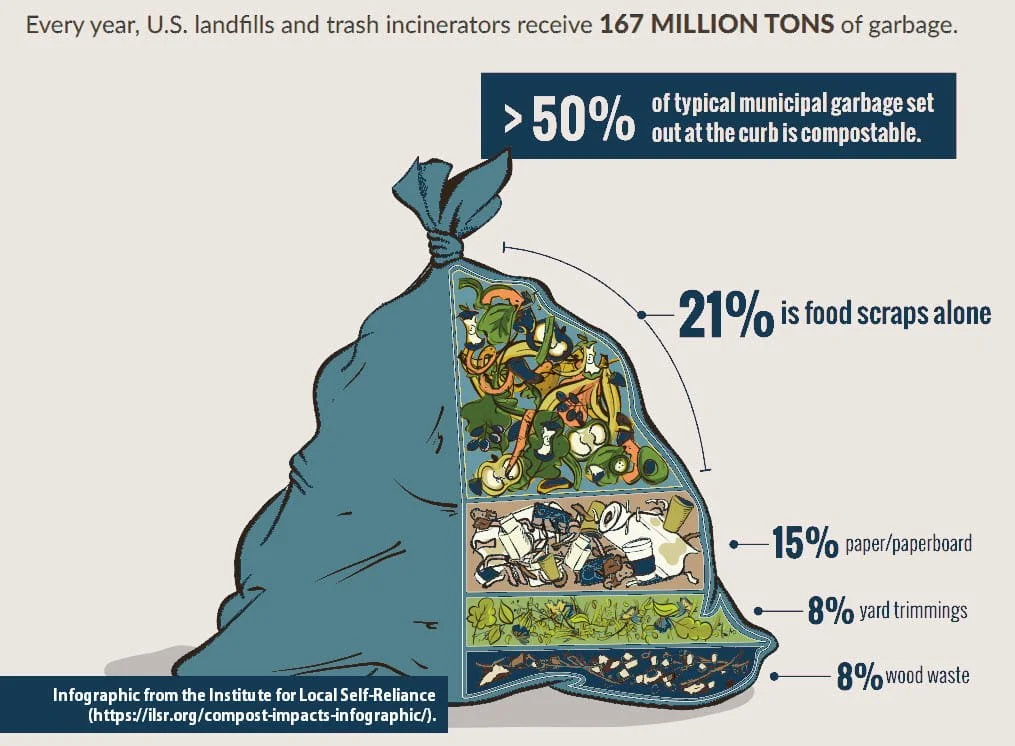
The above image was accessed from MI EGLE’s Food Waste and Recovery page. See the links below to read more! Written in the image above:
“Every year, U.S. landfills and trash incinerators receive 167 million tons of garbage. Greater than 50 percent of typical municipal garbage set out at the curb is compostable. 21 percent is food scraps along. 15 percent is paper/paperboard, 8 percent is yard trimmings. 8 percent is wood waste.
Infographic from the Institute for Local Self-Reliance (https://ilsr.org/compost-impacts-infographic/).”
Those scraps that just went into the trash don’t mean too much, do they? Just a few wasted dollars for something that you no longer want. Actually, those food scraps are one of the largest contributors to municipal solid waste (what goes to the dump). But surely a majority comes from manufacturers and grocers, right? According to ReFed, 2024 data shows that 33.2% of food waste comes from households. That obviously means the other waste producers are causing quite a bit too; however, to create a bigger impact, we need to start finding new ways to manage our wastes at home. Aside from recycling plastics and other materials (check out Ionia’s new Recycling Compactors here), our organic wastes (food scraps, compostable materials, yard waste, etc.) hold great potential for decreasing waste output and preventing economic loss.
Donate to a food bank or food rescue!
Know how long items stay good for under different storage conditions!
Can what you can (especially regarding produce, meat, and soups) before they are beyond the point of return.
If you do have compostable materials, yard waste, and food scraps, start a compost pile!
- USDA
- EPA
- NRDC
Feed good scraps to your flock!
WHAT SHOULD I DO WITH MY ORGANIC/FOOD WASTE?
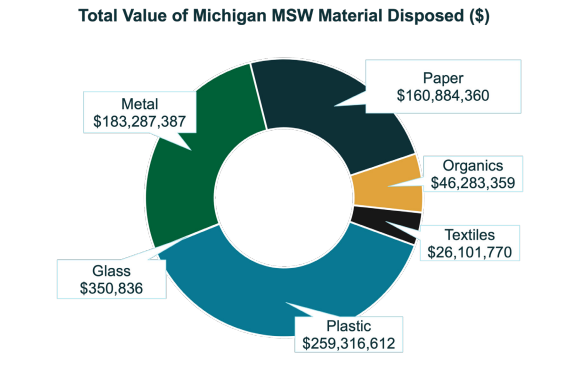
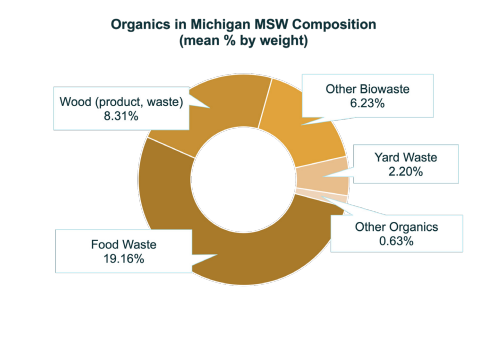
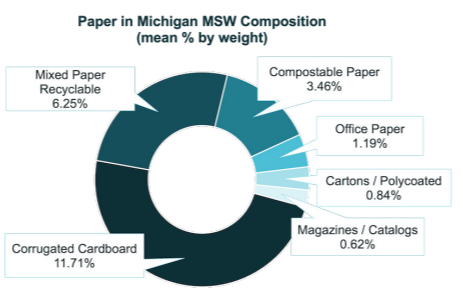
These three infographics are from MiSBF, GVSU, EGLE. 2024. Creating a Circular and Decarbonized Economy: Economic Impact Potential and Characterization of Municipal Solid Waste in Michigan. (See link below)
“Organics in Michigan MSW Compositions (mean % by weight): food waste 19.16%; wood (product, waste) 8.31%; other biowaste 6.23%; yard waste 2.20%; other organics 0.63%.
Paper in Michigan MSW Composition (mean % by weight): 11.71% corrugated cardboard; mixed paper recyclable 6.25%; compostable paper 3.46%, office paper 1.19%, cartons/polycoated 0.84%; magazines/catalogs 0.62%.
Total Value of Michigan MSW Material Disposed ($): plastic $259,316,612; metal $183,287,387; paper $160,884,360; organics $46,283,593; textiles $26,101,770; glass $350,836.”
Want to learn more about food waste? Follow the links below!
Pertinent Pulp Facts:
The twofold nature of used paper products.
Paper products are delightfully double-sided, and not just in a printer. Because paper is a mostly natural material (aside from intermittent bleaching, dyeing, and coating techniques) it can be a great material for both recycling and composting. So what is the better method? Well that depends on what type of paper you are working with. Paper is valuable in the recycling realm. Recycled paper products use 40-70% less energy and 50% less water during manufacturing as compared to newly made paper products. But not everything is recyclable, and paper pulp becomes worn after multiple times being recycled. What should be done with the paper then? This is when composting steps in! See the following table to decide what to do with your paper products. (Those of you viewing on a cell phone, this will be updated soon for your viewing pleasure as well!)
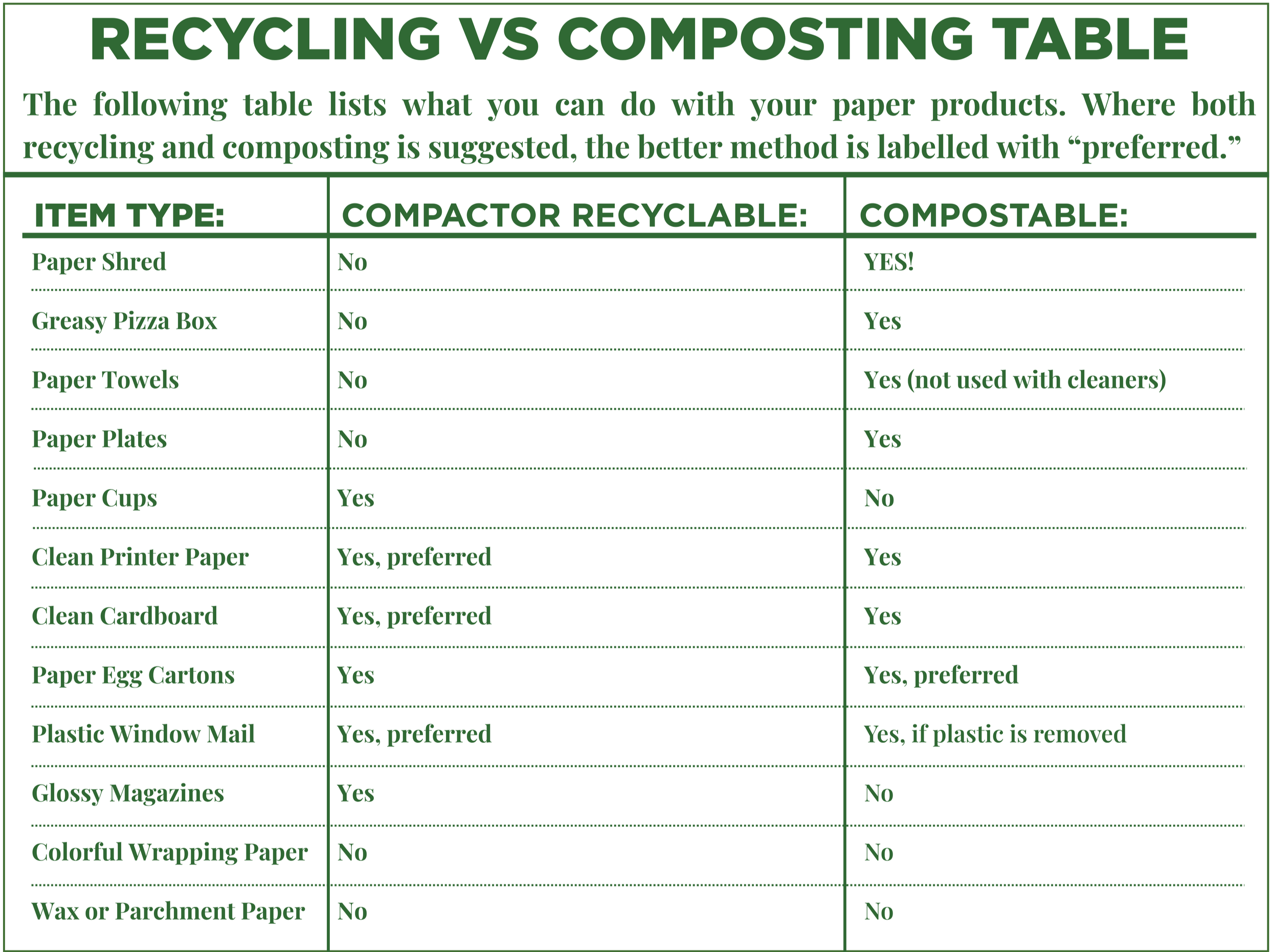
Text from the table above:
The following lists what you can do with your paper products. Where both recycling and composting is suggested, the better method is labelled with “preferred.”
Paper shred not allowed in recycling compactors, should be composted.
Greasy pizza box not allowed in recycling compactors, can be composted.
Paper towels not allowed in recycling compactors, can be composted if free of cleaners.
Paper plates not allowed in recycling compactors, can be composted.
Paper cups are allowed in recycling compactors, should not be composted.
Clean printer paper is allowed in recycling compactors (preferred), can be composted.
Clean cardboard is allowed in recycling compactors (preferred), can be composted.
Paper egg cartons are allowed in recycling compactors, can be composted (preferred).
Plastic window mail is allowed in recycling compactors (preferred), can be composted if the plastic window is removed.
Glossy magazines are allowed in recycling compactors, not compostable.
Colorful wrapping paper is not allowed in recycling compactors, not compostable.
Wax or parchment paper is not allowed in recycling compactors, not compostable.